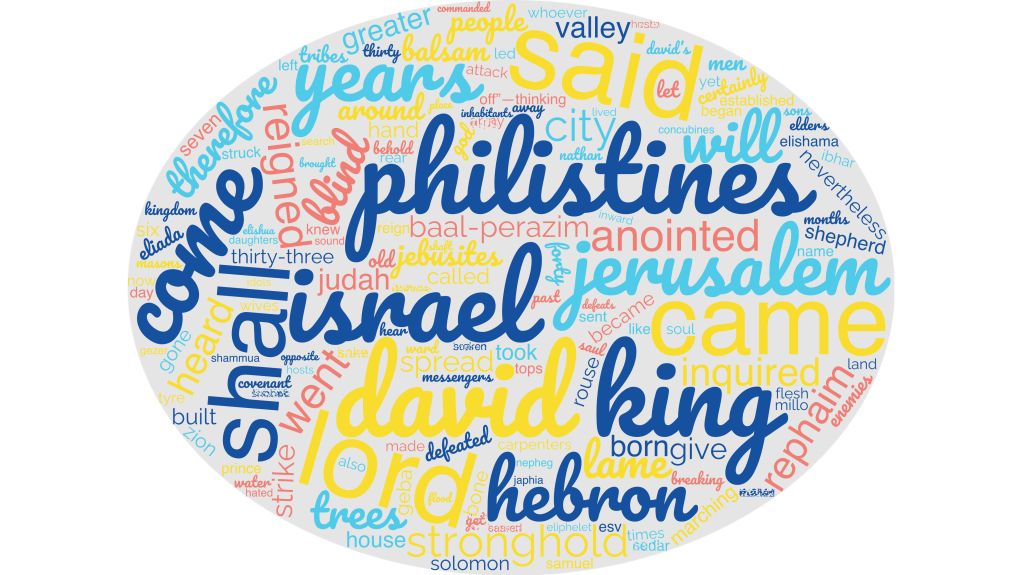
The King and the Kingdom: A Literary and Christ-Centered Reading of 2 Samuel 5
When we turn to 2 Samuel 5, we enter one of the high points of Israel’s story. After years of conflict, delay, and uncertainty, David is finally enthroned as king over all Israel. The text is not simply a dry record of history; it is a rich literary tapestry woven with theological significance. And as we will see, it points us forward to the greater Son of David, Jesus Christ, who himself would have explained to his disciples how this passage spoke of him (cf. Luke 24:44–47).
Let’s walk through the chapter with both literary sensitivity and gospel lenses.
David’s Kingship Recognized (2 Samuel 5:1–5)
The chapter opens with a decisive moment:
“Then all the tribes of Israel came to David at Hebron and said, ‘Behold, we are your bone and flesh. In times past, when Saul was king over us, it was you who led out and brought in Israel. And the LORD said to you, “You shall be shepherd of my people Israel, and you shall be prince over Israel.”’” (vv. 1–2)
Literary Note: The narrative reaches a climax here. Up to this point, David has been anointed three times—once by Samuel (1 Sam 16), once by Judah (2 Sam 2), and now by all Israel. This repetition is not redundancy; it emphasizes the inevitability of David’s kingship under God’s hand. The “bone and flesh” language echoes Adam’s recognition of Eve (Gen 2:23), underscoring covenantal unity between king and people.
Christological Fulfillment: Jesus, the true Shepherd-King, likewise unites his people to himself, not by political agreement but by covenantal blood (Luke 22:20). Just as David’s kingship was divinely appointed, so too was Christ’s. The Father declared of him, “This is my beloved Son” (Mark 1:11). David’s coronation at Hebron points forward to Christ’s coronation at the right hand of the Father.
Imagine Jesus teaching his disciples: “Do you see how the tribes acknowledged David as bone of their bone? So you also are my body (1 Cor 12:27). Do you see how David was anointed three times? So I also was appointed from before the foundation of the world, anointed by the Spirit at my baptism, and crowned with glory after my resurrection.”
Jerusalem Conquered (2 Samuel 5:6–10)
Next comes David’s bold capture of Jerusalem, still in the hands of the Jebusites. Their mocking confidence—“You will not come in here, but the blind and the lame will ward you off” (v. 6)—sets the stage for dramatic reversal. David does indeed conquer the fortress and makes Zion his royal city.
Literary Note: The conquest of Jerusalem is more than military strategy. It is theological geography. Jerusalem will become the city of David, the place where God’s temple will dwell, the locus of God’s reign on earth. The mocking words of the Jebusites highlight the theme of reversal—God’s king triumphs where human pride scoffs.
Christological Fulfillment: Jesus likewise entered Jerusalem, but not with sword in hand. He conquered not by military might but through the cross. The enemies mocked him too: “He saved others; he cannot save himself” (Mark 15:31). Yet in that moment of apparent defeat, Christ was establishing the true Zion—the Church, his holy dwelling place (Eph 2:19–22).
Here, Jesus might say to his disciples: “David entered Jerusalem by force, but I entered it on a donkey. David took the fortress of Zion, but I became the cornerstone rejected by men. His city pointed to mine, the city whose builder and maker is God (Heb 11:10).”
The Kingdom Expands (2 Samuel 5:11–16)
Following the conquest, we read of Hiram king of Tyre sending materials and craftsmen to build David a house. David recognizes this as confirmation:
“David knew that the LORD had established him king over Israel, and that he had exalted his kingdom for the sake of his people Israel.” (v. 12)
Literary Note: The building of David’s house foreshadows the building of God’s house. The narrative links David’s personal dwelling with the people’s corporate good. His rise is not self-exalting; it is covenantal. The listing of children (vv. 13–16) emphasizes dynastic continuity, pointing forward to the promised seed.
Christological Fulfillment: Jesus is the greater temple-builder. He declared, “Destroy this temple, and in three days I will raise it up” (John 2:19). Unlike David, whose house was built by foreign craftsmen, Jesus builds God’s house with living stones—his redeemed people (1 Pet 2:5).
Jesus might have told his disciples: “David knew the LORD exalted him for Israel’s sake. But I tell you, the Father has exalted me at his right hand for your sake, that I may prepare a place for you (John 14:2–3). The sons born to David were many, but the sons and daughters born to me are innumerable, gathered from every tribe and tongue.”
Victory over the Philistines (2 Samuel 5:17–25)
Finally, David faces renewed opposition from the Philistines. Twice they come against him, and twice God grants victory, each in a distinct way. First, David is told to go directly, and God promises to deliver. Second, God commands a more circuitous route, waiting for the sound of marching in the trees—signifying divine presence in battle.
Literary Note: The double victory underscores David’s dependence on divine guidance. He does not presume upon past victories but seeks the Lord afresh. The unusual imagery of marching in the trees conveys the mysterious, sovereign action of God going before his king.
Christological Fulfillment: Jesus too fought battles—not against Philistines but against sin, death, and Satan. At times his victories seemed immediate (casting out demons with a word), at other times delayed (the cross before the resurrection). Yet always he moved in step with the Father’s will.
Jesus could have explained: “David listened for the sound in the trees; I listened for my Father’s voice. His victories came through sword and shield; mine through obedience and cross. Just as David’s enemies were scattered, so I have disarmed the rulers and authorities, triumphing over them in the cross (Col 2:15).”
Conclusion: The Greater David
2 Samuel 5 presents David’s kingship as consolidated, his city established, his house begun, and his enemies defeated. Yet all these victories were shadows. They pointed to a greater King who would unite his people, conquer the true Jerusalem, build the eternal house of God, and defeat the ultimate enemies.
Jesus taught his disciples to read Scripture this way. “Everything written about me in the Law of Moses and the Prophets and the Psalms must be fulfilled” (Luke 24:44). 2 Samuel 5 is one of those places. The chapter sings of the Christ, and when we hear it with gospel ears, we rejoice that the throne of David is forever occupied—by Jesus, the Shepherd-King who reigns for the sake of his people.
✦ Takeaway: Read David’s victories not as the climax but as the preview. In every coronation, conquest, and triumph, hear the voice of Christ, who says: “Behold, something greater than David is here.”

Leave a comment