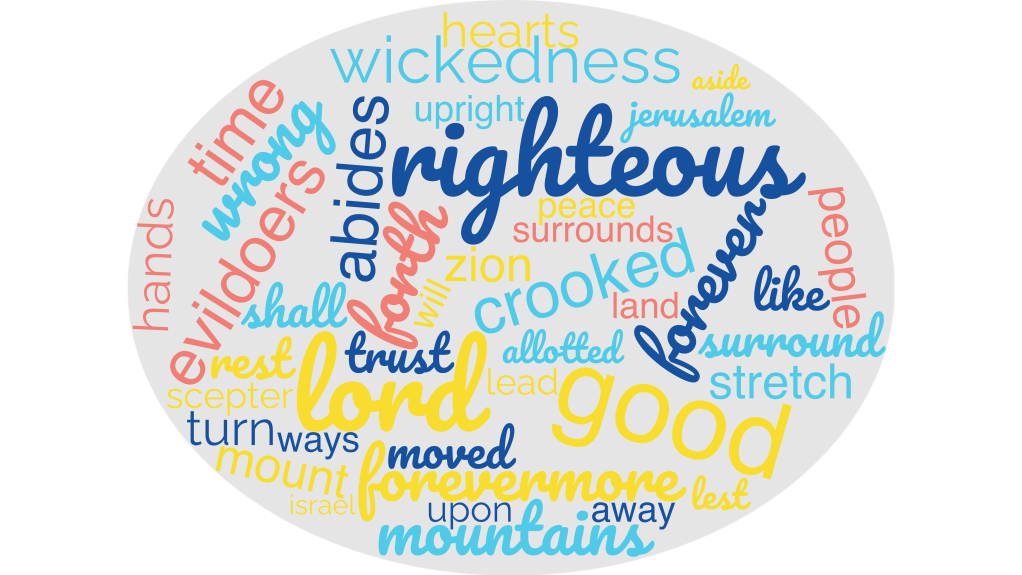
Secure in the Lord: A Literary and Theological Reading of Psalm 125
Psalm 125 belongs to the Songs of Ascents (Psalms 120–134), a collection likely sung by pilgrims traveling to Jerusalem for worship.
Each psalm in this section captures the faith and hope of God’s people as they journeyed upward to Zion.
In Psalm 125, the focus is on security.
The imagery of mountains, encircling protection, and immovable stability all convey one central truth: those who trust in the LORD are safe forever.
Structure and Flow of Psalm 125
The psalm has a tightly woven structure, moving from confidence (Psalm 125:1–2), to reassurance (Psalm 125:3), to petition (Psalm 125:4–5).
Confidence in Stability (Psalm 125:1–2)
Those who trust in the LORD are compared to Mount Zion, which “cannot be moved, but abides forever.”
The simile highlights permanence and resilience.
Unlike shifting sand or fragile foundations, God’s people are secure because their trust is in Him.
The image intensifies in Psalm 125:2: as mountains surround Jerusalem, so the LORD surrounds His people.
The protection is not partial or temporary—it is complete and enduring.
Reassurance of Justice (Psalm 125:3)
The psalmist acknowledges that the “scepter of wickedness” may threaten the land of the righteous, but it will not remain.
This verse captures a key tension of the pilgrim life: the righteous suffer under the shadow of the wicked, yet God’s promise ensures that evil cannot permanently dominate His people.
The concern is pastoral—lest the righteous “stretch out their hands to do wrong.”
The psalm recognizes how prolonged suffering can tempt believers to compromise, but reassures them that God’s justice is sure.
Petition for Mercy and Judgment (Psalm 125:4–5)
The psalm concludes with prayer: “Do good, O LORD, to those who are good, and to those who are upright in their hearts.”
By contrast, “those who turn aside to their crooked ways” will be led away with evildoers.
The final blessing, “Peace be upon Israel,” widens the scope, reminding us that the individual’s security is bound up with the peace of God’s people as a whole.
Psalm 125 Literary Beauty and Contrast
The poetry of Psalm 125 turns on stark contrasts: immovable mountains versus crooked paths, eternal surrounding versus temporary oppression, blessing versus judgment.
The parallelism of Hebrew poetry strengthens these contrasts, making the psalm both memorable and meditative.
The imagery of mountains is particularly powerful.
Mountains represent stability, permanence, and protection.
Just as Jerusalem was geographically encircled by hills, God’s people are spiritually encircled by His care.
The literary effect is to draw the worshiper into a posture of calm trust, even in the face of wickedness.
Theological Significance of Psalm 125
Psalm 125 addresses the question of perseverance and security.
Do God’s people remain safe in His hands, even in times of hardship?
The psalm answers with a resounding yes:
- God surrounds His people perpetually.
- The rule of the wicked is temporary.
- God Himself will distinguish between the upright and the crooked.
This psalm thus undergirds the doctrine of the perseverance of the saints.
Those who trust in the LORD will not be moved—not because of their own strength, but because of God’s steadfast protection.
Psalm 125 Fulfillment in Christ
The New Testament echoes the hope of Psalm 125 in Christ.
Unshakable Kingdom
Hebrews 12:22–28 speaks of believers coming to Mount Zion and receiving “a kingdom that cannot be shaken.”
What Psalm 125 pictured geographically, Christ fulfills eschatologically—we are secured in His eternal reign.
Surrounded by the Shepherd
Jesus says, “I give them eternal life, and they will never perish, and no one will snatch them out of my hand” (John 10:28).
Just as the mountains surround Jerusalem, so Christ’s hand surrounds His sheep.
Peace upon God’s People
The psalm ends with the benediction, “Peace be upon Israel.”
In Christ, this peace extends to Jew and Gentile alike, as He “has made us both one” and “preached peace to you who were far off and peace to those who were near” (Ephesians 2:14–17).
Conclusion: Unmoved and Surrounded
Psalm 125 offers pilgrims—and us—a picture of unshakable security.
To trust in the LORD is to be as immovable as Mount Zion, surrounded on all sides by divine protection.
Though the wicked may trouble the righteous, their rule will not last.
God will do good to His people and establish peace for them forever.
For the Christian, the psalm finds its fullest meaning in Jesus Christ, the Son of David and King of Zion.
In Him, we are unshakable, surrounded, and destined for eternal peace.


Leave a comment