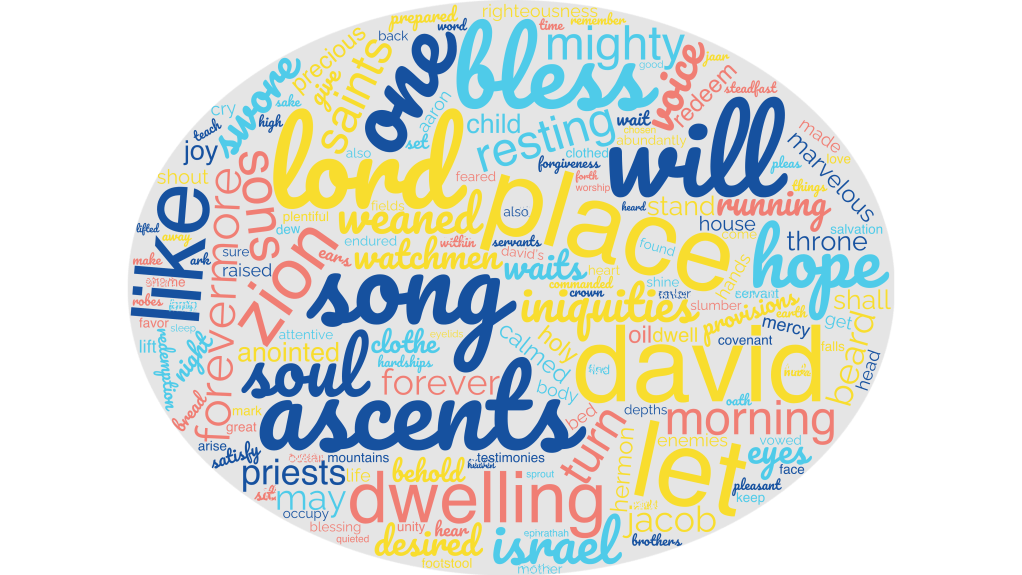
The Songs of Ascent: A Journey of Worship from Earthly Trouble to Heavenly Joy
The collection of Psalms known as the Songs of Ascent (Psalms 120–134) forms one of the most distinct groupings in the Psalter. Each psalm bears the superscription “A Song of Ascents,” marking them as a unified set. Traditionally, they were sung by pilgrims traveling “up” to Jerusalem for the great festivals (Deuteronomy 16:16). But their placement in the Psalter and their literary design show that they are far more than travel songs. They map out the spiritual pilgrimage of God’s people—from distress in a foreign land, to the hope of God’s presence in Zion, and ultimately to the blessing of eternal communion with Him.
The Songs of Ascent are not random. Their order is intentional, divinely arranged to portray the life of faith as a journey toward the presence of God. They begin in lament and end in blessing. Along the way, they call us to trust, to unity, to joy, and to perseverance. Ultimately, they point us to Christ, the One who secures our pilgrimage and leads us to the heavenly Zion.
The Structure of the Songs of Ascent
Scholars have noted several structural features in Psalms 120–134:
Framing Movement (120–121 and 133–134) – The set opens with exile and ends with blessing in the house of the Lord.
Triadic Patterns – Many see a cycle of three-psalm groupings, often moving from trouble → trust → triumph.
Progression of Themes – The psalms move from individual lament (Psalm 120) to corporate worship and blessing (Psalm 134). The worshiper journeys from the world’s hostility to God’s holy city.
Songs of Ascent Literary Analysis
Beginning in Trouble (Psalm 120–122)
- Psalm 120 – The journey begins in exile: the psalmist laments living among deceitful, warlike people. Pilgrimage starts with the recognition that we are not at home in this world.
- Psalm 121 – The pilgrim looks to the hills, to God who keeps him. From distress, the psalmist turns his eyes to God as the faithful Keeper.
- Psalm 122 – The arrival at Jerusalem. The pilgrim rejoices at the city of God, the center of worship and unity.
Trust and Security in God (Psalm 123–125)
- Psalm 123 – A prayer for mercy, lifting eyes to God as master. The pilgrim learns dependence.
- Psalm 124 – A hymn of deliverance: “If the LORD had not been on our side…” A testimony to God’s saving power.
- Psalm 125 – Assurance of security: those who trust in the Lord are like Mount Zion, unshakable.
Restoration and Joy (Psalm 126–128)
- Psalm 126 – A remembrance of past restoration and prayer for new renewal. Laughter and joy mix with tears of sowing.
- Psalm 127 – Wisdom on God’s sovereignty: building, protecting, and family life depend entirely on the Lord.
- Psalm 128 – A vision of the blessed life: the fear of the Lord brings flourishing in family, work, and nation.
Perseverance in Trials (Psalm 129–131)
- Psalm 129 – A communal lament: Israel has been afflicted from youth, but the wicked will not prevail.
- Psalm 130 – A cry from the depths: forgiveness and hope are found in God alone.
- Psalm 131 – A picture of humble trust: the soul quieted like a weaned child with its mother.
The Climax of Zion’s Blessing (Psalm 132–134)
- Psalm 132 – A prayer for God’s presence in Zion, recalling David’s zeal for the ark and God’s promises to his line. It looks to the Messiah who will sit on David’s throne forever.
- Psalm 133 – A celebration of unity: God’s blessing flows like oil and dew when His people dwell in harmony.
- Psalm 134 – The conclusion: a call to bless the Lord in His house, and a reciprocal blessing from Zion upon His people. The pilgrimage has reached its destination.
Songs of Ascent Literary Features
Pilgrimage Motif – These psalms are structured like steps on a journey. The repetition of “ascents” and the thematic progression from trouble to Zion reflect an upward spiritual climb.
Simple, Memorable Imagery – Mountains, family life, harvests, city walls, oil, and dew—all imagery grounded in everyday life yet used to point to God’s covenant blessings.
Balance of Individual and Corporate Voice – The psalms oscillate between “I” (personal trust) and “we” (corporate identity), teaching that faith is both personal and communal.
Crescendo of Praise – The sequence builds toward the climax of unbroken blessing in the final psalm.
Songs of Ascent Theological Themes
Life as Pilgrimage – Believers are sojourners in a hostile world, journeying toward God’s presence (Hebrews 11:13–16).
God as Keeper – The repeated theme of God’s watchful care (especially in Psalms 121, 125, 127) undergirds the journey.
Unity of God’s People – The Songs celebrate corporate solidarity, culminating in Psalm 133.
The Hope of Zion – The city of God is not just a geographical place but the symbol of God’s dwelling with His people.
Joy through Trials – These psalms hold together suffering (Psalm 120, 129, 130) and joy (Psalm 126, 128, 133), showing that the path to blessing runs through hardship.
Songs of Ascent Fulfillment in Christ
The Songs of Ascent anticipate the greater pilgrimage fulfilled in Christ:
The True Pilgrim – Christ Himself journeyed to Jerusalem, facing hostility, yet perfectly trusted His Father (Luke 9:51).
The Keeper of Israel – He embodies the God who neither slumbers nor sleeps (John 10:28–29).
The New Zion – Christ is the cornerstone of God’s temple, and the church is His dwelling place (Eph. 2:19–22).
The Greater David – Psalm 132 points to Jesus as the eternal heir of David’s throne (Luke 1:32–33).
Unity and Blessing – Through His death and resurrection, Christ unites His people into one body (John 17; Ephesians 4:3–6).
The Heavenly Ascent – Believers follow Christ, the forerunner who has ascended into heaven (Hebrews 6:20), where the pilgrimage finds its final destination.
Conclusion
The Songs of Ascent are more than festival hymns—they are a carefully ordered sequence portraying the journey of God’s people. They begin in exile and longing, but they end in blessing and joy in God’s house. Along the way, they teach dependence, perseverance, unity, and hope.
For Christians, these psalms remind us that we are pilgrims headed toward the heavenly Jerusalem. The journey is marked by trials and waiting, but our Keeper never slumbers, and our end is secure in Christ. As the last psalm in the collection reminds us, the goal of the pilgrimage is not only to bless God but also to receive His blessing forevermore.

Leave a comment