His Steadfast Love Endures Forever: A Literary and Theological Analysis of Psalm 136
Introduction
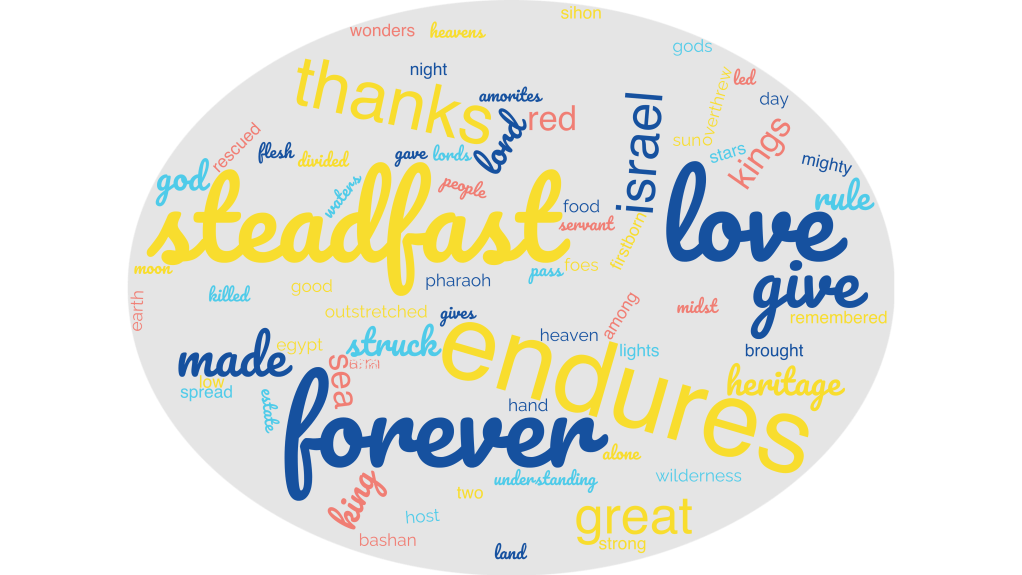
Psalm 136 is one of the most recognizable psalms in the entire Psalter, often called “The Great Hallel”—the great psalm of praise. It is unique in its structure, repeating after every line the refrain: “for his steadfast love endures forever.” This refrain is not simply poetic ornamentation. It is the central theme of the psalm, the lens through which all of God’s works—creation, redemption, providence, and kingship—are to be understood.
This psalm functions as a liturgical celebration of Yahweh’s mighty acts in history, meant to be sung antiphonally: a leader declares God’s deed, and the congregation responds with the refrain. The repetition engrains the truth of God’s covenant love into the minds and hearts of His people.
Psalm 136 Structure
Psalm 136 is carefully organized into four main movements, each highlighting God’s enduring ḥesed (“steadfast love,” “covenant loyalty”):
Psalm 136:1–3: Call to Thanksgiving
The psalm begins with a triple summons to give thanks—to the LORD, the God of gods, and the Lord of lords.
This triple invocation underscores God’s supremacy and uniqueness as the true sovereign.
Psalm 136:4–9: God the Creator
The psalmist praises God for His wonders in creation: making the heavens, spreading out the earth, forming the lights of the sky.
The sun, moon, and stars are not deities (as in surrounding nations) but creations of the one true God.
The refrain reminds us that creation itself flows from divine love, not from conflict or chance.
Psalm 136:10–22: God the Redeemer in History
This section recalls the exodus: striking down Egypt’s firstborn, dividing the Red Sea, and leading Israel safely through.
Pharaoh’s army is overthrown, and God guides His people in the wilderness.
The conquest of the land is also remembered, especially victories over Sihon and Og.
These historical events are interpreted through the same refrain: each act of judgment and deliverance was motivated by God’s steadfast love.
Psalm 136:23–26: God the Sustainer and Universal Lord
The psalmist brings the song to the present: God remembered Israel in their low estate and delivers His people still.
He provides food for all flesh, extending His care beyond Israel to the whole creation.
The psalm concludes with a final call to give thanks to the God of heaven.
Psalm 136 nLiterary Features and Themes
Refrain as Theological Anchor
The refrain “for his steadfast love endures forever” appears 26 times. This is not vain repetition; it is theological emphasis. Every act of God—whether creation, judgment, redemption, or provision—must be read through the lens of His enduring love. The refrain is the interpretive key.
Covenant Love in Action
The Hebrew word ḥesed is notoriously difficult to translate. It combines ideas of loyal love, covenant faithfulness, mercy, and grace. In Psalm 136, ḥesed is not abstract. It is expressed in creation, in Israel’s history, and in daily provision.
Cosmic and Historical Scope
The psalm moves from creation (cosmic) to Israel’s redemption (historical) to God’s ongoing care (personal). The pattern shows that the God who formed the stars is the same God who cares for His people. His love spans eternity and embraces every realm.
Liturgical Rhythm
The psalm’s antiphonal structure invites participation. It is designed not only to be read but to be experienced in community. Its rhythm engrains truth through corporate confession.
Psalm 136 Theological Significance
God’s Love as the Motive of All His Works
Psalm 136 insists that every mighty act of God is driven by His steadfast love. Even His acts of judgment—such as striking Egypt—are presented as expressions of love, because they secure His people’s salvation and uphold His covenant.
Memory and Worship
The psalm rehearses the past so that God’s people may trust Him in the present. Remembering the Red Sea, the wilderness, and the conquest fuels present confidence in God’s unchanging love.
Universal Provision
The closing verses broaden the scope: God gives food to “all flesh” (Psalm 136:25). His covenant love toward Israel overflows into general providence for the whole world. This anticipates the extension of His saving love to the nations through Christ.
Psalm 136 Pointing to Christ
Psalm 136 reaches its climax in Christ, the ultimate demonstration of God’s enduring ḥesed.
In creation, Christ is the Word through whom all things were made (John 1:3).
In redemption, Christ is the true Passover Lamb whose blood delivers from wrath (1 Corinthians 5:7).
In provision, Christ is the Bread of Life who feeds His people eternally (John 6:35).
In kingship, Christ is the Lord of lords and King of kings (Revelation 19:16).
Most of all, the refrain finds its fulfillment at the cross. The supreme declaration that “His steadfast love endures forever” is written in the blood of Jesus Christ, who loved His people to the end (John 13:1).
Conclusion
Psalm 136 is a hymn of praise that anchors God’s people in the unchanging reality of His steadfast love. Through creation, redemption, and providence, God’s covenant faithfulness endures. And in Christ, that refrain is sealed forever. Every believer can join in the psalmist’s song: “Give thanks to the LORD, for he is good, for his steadfast love endures forever.”

Leave a comment