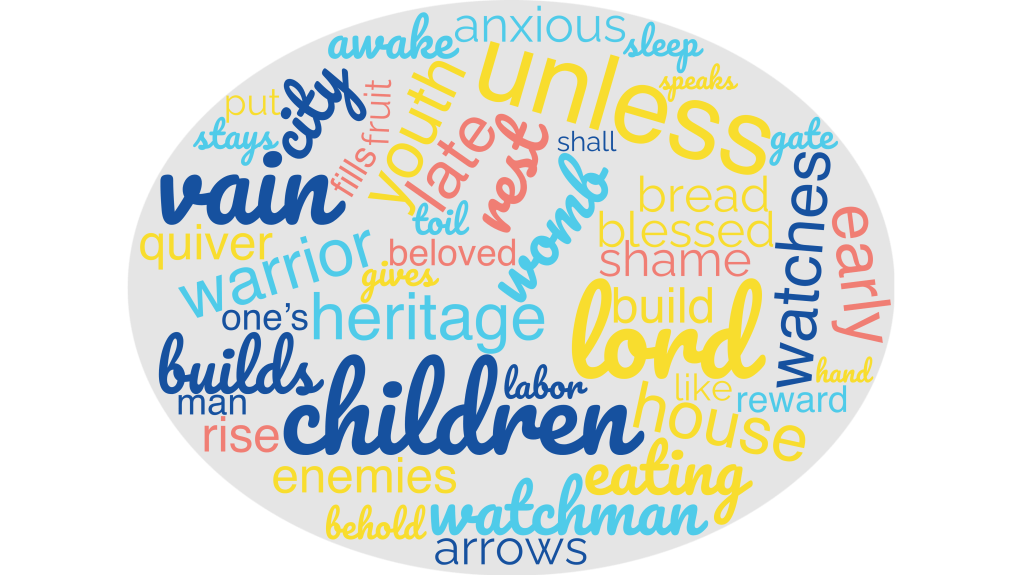
Unless the LORD Builds: A Literary and Theological Reading of Psalm 127
Psalm 127 is one of only two psalms attributed to Solomon (the other being Psalm 72).
Fittingly, its themes of building, security, labor, rest, and children all resonate with Solomon’s life and reign.
As part of the Songs of Ascents (Psalms 120–134), it teaches pilgrims ascending to Jerusalem that true fruitfulness comes not from human effort but from God’s blessing.
It is a psalm about dependence—our work, our safety, our rest, and even our families are all gifts from the Lord.
Structure and Flow of Psalm 127
The psalm divides into two main parts:
- The Futility of Self-Reliance (Psalm 127:1–2)
- The Blessing of God’s Gift (Psalm 127:3–5)
This balance between warning and blessing underscores the central message: human striving apart from God is vain, but God’s gracious gifts bring lasting joy and security.
The Futility of Self-Reliance (Psalm 127:1–2)
The opening lines are memorable for their rhythmic repetition:
“Unless the LORD builds the house,
those who build it labor in vain.”“Unless the LORD watches over the city,
the watchman stays awake in vain.”
The double “unless” introduces the theme of futility.
No matter how much effort is exerted, without the Lord’s active involvement, it amounts to nothing.
The imagery moves from house-building (domestic life) to city-watching (public security), covering the full range of human endeavors.
Psalm 127:2 extends the point: rising early, staying up late, and eating “the bread of anxious toil” accomplish little.
By contrast, God “gives to his beloved sleep.”
The imagery is striking: while humans wear themselves out in ceaseless striving, God grants rest to His people as a sheer gift of love.
The Blessing of God’s Gift (Psalm 127:3–5)
The second half of the psalm shifts from futility to blessing.
Here children are highlighted as a gift from the Lord:
“Behold, children are a heritage from the LORD,
the fruit of the womb a reward.”
The imagery turns martial: children are like “arrows in the hand of a warrior.”
In the ancient world, a large family provided protection, strength, and honor.
Psalm 127:5 concludes with confidence:
“Blessed is the man who fills his quiver with them!
He shall not be put to shame when he speaks with his enemies in the gate.”
In literary terms, the psalm moves from vain human effort to fruitful divine blessing.
Work done apart from God is empty; blessings given by God endure.
Psalm 127 Literary Beauty and Contrast
The psalm hinges on contrast:
- Vain labor versus God-given fruitfulness
- Anxious toil versus restful sleep
- Human effort versus divine gift
The parallelism reinforces this pattern, with the opening “unless the LORD…” clauses setting the stage for the climactic “Behold, children are a heritage from the LORD.”
The structure itself embodies the shift from vanity to blessing.
Theological Significance of Psalm 127
Psalm 127 confronts the illusion of autonomy.
We are tempted to believe that through hard work, strategic planning, or sheer determination, we can secure our futures.
The psalm insists otherwise: without the Lord, our efforts collapse into vanity.
This does not encourage passivity—builders still build, watchmen still watch, farmers still plant.
But it reorients the heart: success and fruitfulness come not from our toil but from God’s providence.
The psalm also dignifies family life, portraying children not as burdens but as blessings.
In a culture that often views children as obstacles to personal ambition, Psalm 127 reorients us to see them as God’s reward, gifts that bring strength and joy to a household.
Psalm 127 Fulfillment in Christ
In Christ, the themes of Psalm 127 find their ultimate fulfillment:
The True Builder
Jesus is the greater Solomon, the One who builds God’s true house, the church.
“I will build my church, and the gates of hell shall not prevail against it”
(Matthew 16:18)
Our labor is not in vain because Christ Himself builds (1 Corinthians 15:58).
The True Watchman
Christ is the Shepherd-King who guards His people.
He neither slumbers nor sleeps (Psalm 121:4).
Our security rests not in human vigilance but in His care.
The True Rest-Giver
Jesus invites the weary, “Come to me, all who labor and are heavy laden, and I will give you rest” (Matthew 11:28).
He gives the deep rest of reconciliation with God.
The True Heritage
Believers are called children of God through Christ (John 1:12).
The ultimate “heritage” is the family of faith, born not of flesh but of the Spirit (Galatians 3:26–29).
Conclusion: Resting in the Lord’s Gifts
Psalm 127 teaches us to renounce the illusion of self-sufficiency.
Unless the Lord builds, watches, and blesses, our striving is empty.
But when our work and families are rooted in Him, they become gifts of grace that endure.
For the pilgrim people of God, this psalm points to Christ, the true builder of God’s house and the giver of rest.
In Him, our labor is fruitful, our security unshakable, and our inheritance everlasting.


Leave a Reply