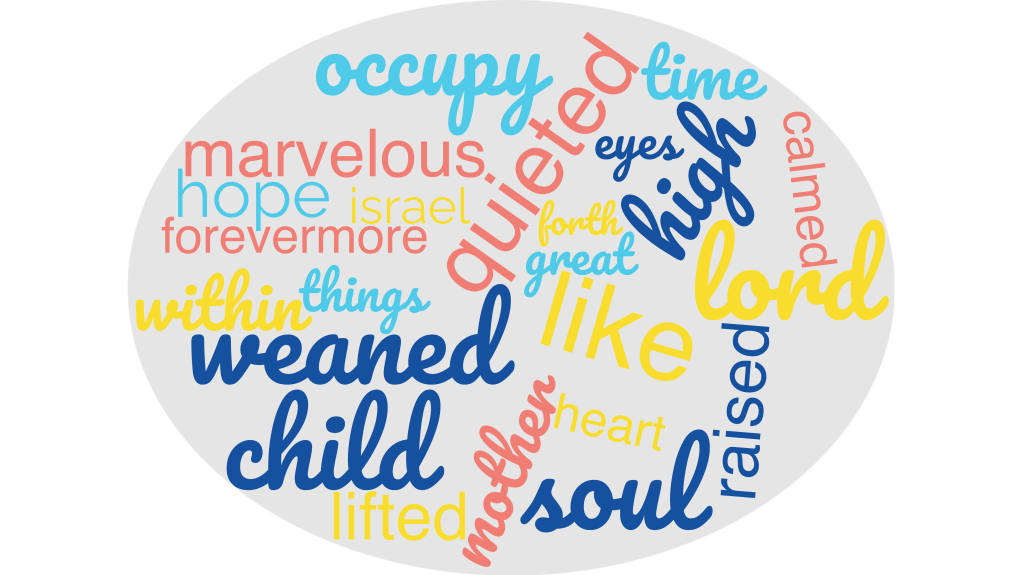
The Quieted Soul: A Literary Analysis of Psalm 131
Psalm 131 is one of the briefest psalms in the Psalter—only three verses—but its brevity conceals profound depth. This Song of Ascents offers a picture of spiritual maturity, humility, and trust in God. Unlike the cries of desperation in the preceding psalm (Psalm 130), Psalm 131 portrays a soul that has found rest, not in self-sufficiency or ambition, but in childlike dependence on the Lord.
It is a psalm especially suited for pilgrims, for those traveling not only to Jerusalem but through life itself, reminding God’s people that peace comes not from striving, but from trusting.
Structure of the Psalm
Psalm 131 moves with beautiful simplicity through three verses:
Personal Humility (v. 1): The psalmist confesses that his heart is not proud, his eyes are not haughty, and he does not chase after things too great or marvelous for him.
Contentment in God (v. 2): He compares his soul to a weaned child, quieted and resting with its mother.
Communal Exhortation (v. 3): The psalm concludes with a call for all Israel to hope in the Lord now and forever.
The psalm begins with the “I,” shifts to the inner state of the soul, and then widens to embrace the whole community.
Literary Features
Negation Before Affirmation
Verse 1 is filled with negatives: not proud, not haughty, not meddling in things too great. This rhetorical device clears away false notions of strength before presenting the true source of peace in v. 2. The psalmist first defines maturity by what it is not before showing what it is.
The Child Metaphor
The central image is that of a weaned child resting with its mother (v. 2). This is not an infant demanding milk, but a child who has moved past restless craving. The metaphor emphasizes contentment, security, and relational trust rather than striving or ambition.
Movement from Individual to Corporate
Like many of the Songs of Ascents, the psalm transitions from personal testimony (“I have calmed and quieted my soul”) to communal exhortation (“O Israel, hope in the LORD”). This pattern shows how the inner life of one believer can serve as encouragement to the wider people of God.
Minimalist Beauty
The brevity of the psalm contributes to its message. Its calm, uncluttered simplicity mirrors the quieted soul it describes. The psalm doesn’t overwhelm the reader with detail—it rests, just as the soul rests.
Theological Themes
Humility Before God
The psalm begins with a confession of humility. True maturity is not grasping at things beyond us but accepting our creaturely limits. It rebukes both intellectual pride (eyes lifted high) and practical pride (meddling in great matters).
Contentment Through Trust
The heart of the psalm is contentment. Like a weaned child, the believer learns to trust God not only for immediate provision but for His presence. The image suggests growth: moving from demanding God’s gifts to resting in God Himself.
Corporate Hope in the Lord
The psalm ends with a call for Israel to place its hope in the Lord “from this time forth and forevermore.” The peace of one believer becomes a pattern for the whole community. The quieted soul is not an end in itself but a testimony to the sufficiency of God.
Christological Fulfillment
Psalm 131 points us to Christ in several ways:
The Perfect Humility of Christ: Jesus, though Lord of all, humbled Himself, not grasping for greatness but submitting to the Father’s will (Phil. 2:6–8). He embodied verse 1 perfectly.
The Rest He Provides: Christ invites the weary and heavy laden to find rest in Him (Matthew 11:28–30). He Himself lived in quiet dependence on the Father, showing what it means to be like the weaned child.
Hope for the People of God: Because of Christ’s death and resurrection, God’s people have hope “from this time forth and forevermore.” Our contentment flows not from circumstances but from union with Christ.
Conclusion
Psalm 131 is a jewel of simplicity and depth. It teaches us that true maturity is not restless striving but childlike trust. It warns against pride and ambition that lead to anxiety, and it points us to the peace that comes only from resting in God.
For the pilgrim on the way to Jerusalem—or the Christian on the way to the New Jerusalem—Psalm 131 is a reminder that the quieted soul is not achieved through self-mastery but through surrender. In Christ, we find the humility, the rest, and the everlasting hope that the psalm holds out.


Leave a reply to Psalm 132 Explained – Explaining The Book Cancel reply